
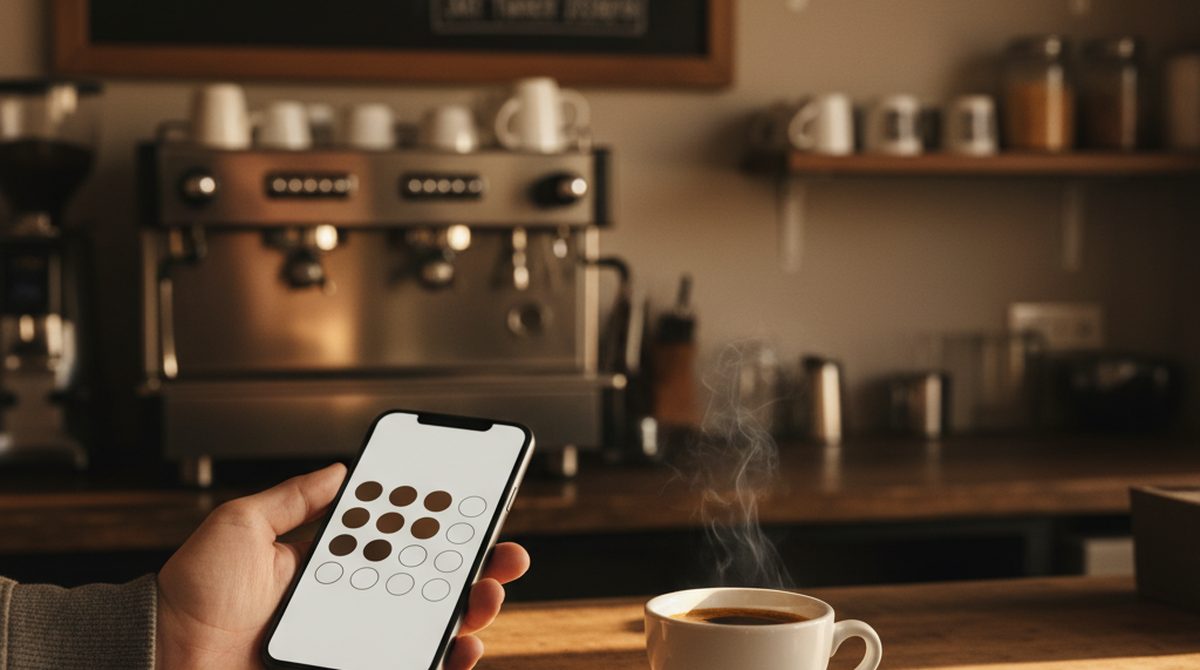
A friend runs a small café on a side street. A few weeks ago she showed me her stamp cards — a drawer full of paper cards, some redeemed, plenty half-full, several with three different stamp patterns on them. "Some customers bring their card with eight stamps. Some of those stamps weren't even put there by us." The stamp looks like a worn-out circle. With a black felt pen, anyone can fake it in 30 seconds.
She'd wanted to switch for a while. A custom app was too expensive and too complicated. But stamp cards weren't fun anymore either. What do you do when the old system stops working and the new one is too big?
Why the Stamp Card Has Survived This Long
Stamp cards are surprisingly persistent. They've been around for decades in almost every café, bakery, and barber shop. Three reasons:
- Low overhead for the business. Print cards, buy a stamp, done. No accounts, no server, no app.
- Low barrier for the customer. No signup, no privacy modal, no app download. Take the card, that's it.
- Visible progress. Counting stamps is satisfying. Eight out of ten — only twice more.
The concept isn't broken. The paper-and-felt-pen execution is.
What's Broken About Stamp Cards
What my café friend listed:
Loss and forgetting rate is high. Cards disappear into wallets, bags, drawers. Plenty of customers never finish a card — they've already lost it before they come back for a tenth coffee.
Stamp forgery. Anyone who's seen the stamp once can copy it. With small cafés using generic star stamps from an office supply store, it's particularly easy.
Print costs. 500 cards from a local printer easily run $80 to $120. Higher volumes get cheaper per piece, but small cafés rarely need 5,000 cards at once. The extras then sit in a box for years.
No data. You don't know who's actually a regular. Who's redeemed before? What day brings the most stamps? The stamp card has no idea who its holder is.
Paper waste. A café with 100 cards handed out per month already produces 1,200 cards a year — most of them ending up in the trash eventually.
What a Wallet Stamp Card Changes
A wallet pass can implement the stamp-card concept directly, with a few key differences:
Dynamic stamp display. The pass can be updated through the Apple PassKit web service API (Google Wallet has the same capability). The customer gets a push: "8 of 10 — only two more!"
No loss. The wallet is always with you. The card doesn't get forgotten because the phone doesn't get forgotten.
Forgery-proof. The stamp comes from the server, not from a felt pen. No one can add their own stamps.
Push reminders. If a customer hasn't been in for five days, the pass can deliver a gentle nudge: "Two more stamps to a free coffee." That's a way to bring lapsing customers back.
Anonymous usage data. How many customers currently have active cards? When do most come in? Who never redeems? Better decisions on a real basis.
No waste. A file instead of a paper card.
What This Costs the Café in Effort
Reality check: wallet stamp cards aren't completely free of tech setup. But it's manageable:
Choose a wallet-pass provider. There are several small providers that do exactly this — pass template plus a stamp backend. Prices start around $30 per month and up, depending on the provider, volume, and features.
Design the pass template. Logo, background color, reward text. With most providers, half an hour's work.
Stamp mechanism at the till. A tablet or phone with the provider's app — staff scans the customer's QR code, the stamp is added. Alternative: customer scans a QR code at the till to trigger the stamp.
Optional: pass generation through the website. Customers can grab a pass themselves without the café having to do anything actively.
Pass-building itself — creating the wallet-pass file — is doable in-house with tools like OtterWallet. The stamp mechanism is then handled by other tools, or you build something with the pass-update API yourself. For small businesses with a tech-savvy friend or two, very realistic.
Hybrid Approach for the Transition
Nobody has to replace all stamp cards overnight. The pragmatic transition:
- Keep paper cards for customers without smartphones or who don't want a wallet pass.
- Offer wallet for the regulars who've been asking "do you have an app or something?" for months. They'll take it eagerly.
- Drift over time. When 80 percent of cards are wallet, you can stop printing paper cards. The remaining 20 percent get a leftover paper card or a special arrangement.
The hybrid approach also reduces risk: if the digital system goes down for a day, you still have the old method as a fallback.
What It Costs — and What It Saves
Rough numbers from my café friend:
- Stamp card printing: about $200 per year (two print runs)
- Office-supply stamp + ink: about $30
- Time spent in "where's the card?" conversations: hard to quantify
Wallet pass setup with a stamp backend: about $50–100 per month. Annualized, more expensive than paper — but you get push reminders, data, no waste, no forgery.
For small cafés this is the discussion: paper is cheap, wallet is more — but wallet brings more back. The break-even depends on how much the push reminders actually move the needle.
Bottom Line
Stamp cards aren't dying because the concept is bad. They're dying because the paper-and-felt-pen setup doesn't fit a world where customers have everything else on their phones already.
For small cafés and bakeries, wallet is the next logical step — cheaper than a custom app, less heavy than a full loyalty program, closer to the original stamp-card logic. Anyone who takes the step now has a few years to refine the system before everyone else catches up.